Once upon a time, there was a king and a queen who had seven sons. They loved their children with all their hearts, but when the queen fell pregnant again, she sighed with longing for a daughter.
“Oh,” she said, “I would trade all my sons for just one daughter.”
With a loud noise, a tall woman appeared in the queen’s chamber. “That is a wicked wish, but you shall have it!” and with another boom, she disappeared.
When the time came for the queen to deliver, a baby girl was born. But the moment she cried, all seven of her brothers were transformed into swans, and rising into the air, they flew away.
The girl grew, lovely, but lonely. One day, she asked her mother why she did not have brothers and sisters the way other children did. Her mother, crying, confessed to her foolish, whispered half-wish and the disappearances of her sons.
“The fault is mine,” she said, “and so I will bring them home to you.”
The story of The Wild Swans (or geese or ravens or blackbirds) has been a favorite of mine long before old women in grocery aisles consoled me at my collection of sons, my lack of daughters. The fact that the sister in the story braves the world, the nettle patch, and even the loss of her babies and her own possible death for the sake of her siblings called to me deeply as the sister of siblings that I was not always able to protect.
My story is hardly unusual. The parentification of oldest daughters is an established phenomenon. The fact that the court appointed case manager told me, at twenty-one, that she would have recommended my youngest siblings be placed in my custody if I had been older is something I’ve always had mixed feelings over. Should she have said that? becomes It wasn’t all in my head. This really was a terrible, toxic situation. becomes God, I wish they had given me custody. becomes Actually they made the right choice, that would have been terrible, and not because I would have been parenting siblings.
This cycle is one of those running in the background of my mind: reliable, consistent white noise even decades later. Occasionally, after a conversation with a sibling, the volume rises, a cacophony of guilt. Recently, in a conversation with the brother just younger than me, we realized that our only “childhood” regret was our inability to save our younger siblings from further trauma as we made our own first steps into adulthood.
She left their castle and went out into the world. In the woods, she found a cabin, and rested there, and in the evening, a great whirlwind sounded outside. Seven swans flew in through the windows, and as each alit, they turned into young men. The girl was afraid, but when the eldest stepped forward and demanded to know who she was, she said, “I am wandering the world looking for my seven brothers, who disappeared from the face of the earth the hour of my birth.”
Then her brothers wept, “You are our sister!” and the night was spent in tears and rejoicing, but as morning approached, they told her, “We must become swans again, for this is how we were cursed.”
“Brothers,” she pleaded, “I am the cause of your misfortunes. Tell me how I might lift this curse.”
Her brothers were silent, for they knew the task ahead would be arduous.
The barbed hook of parentification is that it is not a bad thing for siblings to defend each other, but it is a bad thing for children to feel guilty for the harm done to them or their siblings by the adults meant to protect them.
“If you wish to free us, you must gather nettles, spin them into thread, then weave them into cloth, and sew the cloth into shirts. You must make one for each of us. During the time you work, we must remain swans, and until you finish, you must not speak or sing or laugh or cry out, or we will remain swans forever.”
“I will do it,” she cried.
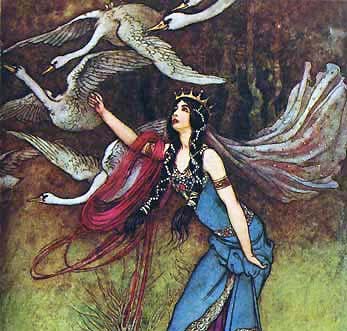
Warwick Goble, The Wild Swans
So her brothers embraced her, and blessed her, and when the sun rose, they leapt into the sky as swans, and shrouding herself in silence, burying her voice, she left the cottage to gather nettles.
For four years she worked. She gathered the nettles from the woods, worked under the trees that sheltered her, and slept in the cottage her brothers had left her. Each year she completed a shirt, and laid it aside, thinking of her brothers. Then, in the summer of the fifth year, a royal hunting party came to the forest.
The narrative becomes complex as the parentified child grows into adulthood, dragging the dregs of guilt and compensation, swallowing whole one’s own free dreams. For myself, feeling my loyalty pulled in new directions was, at times, excruciating. For myself, finding my silence created barriers between me and my new, nascent family was a shock. Silencing myself had been my means of protecting, parenting during my childhood, but silencing oneself has dangerous consequences.
One day, the young king, separated from his group, rode up to the cottage. Seeing the young woman spinning in the garden, he was taken with her beauty and industry. Although she was silent, he determined to woo her and make her his queen.
Daily, he visited the cottage, speaking to her as she worked, and she was won by his gentle ways. With a nod and a smile, she agreed to go with him and be his wife, and gathering her nettles and thread and cloth and shirts, her spindle and her loom, he lifted her onto his horse, and led her from the woods.
They were married, and the young woman found joy in her husband, and a supply of nettles in the churchyard at the edge of the city. The people loved their queen, even if they thought her strange. But the king’s stepmother burned with envy, and when their first child was born, entering the room as the new mother slept, she threw the baby from the window, into the maw of a wolf below. Then pricking her finger, she wiped the blood on the young queen’s face and screamed for the guards that the mother had devoured her child.
Her husband refused to believe that his wife, white faced with grief, would have done such a thing, but the old queen murmured among the people. Why will she not defend herself? She has always been strange. Look at how she haunts the graveyard! The king has married a witch.
Through her grief, the young woman continued gathering, spinning, weaving, and sewing. She was brought to bed with her second child as she wove the cloth for the seventh shirt. The king posted guards in his wife’s room to protect her and the babe, but the old queen bribed them, and again, she took the baby from beside the sleeping mother, again, threw it to the wolf, again, smeared blood and screamed that the queen had devoured her child.
Helen Stratton's illustrations for The Wild Swans
This time, the king could not protect his wife from the people. They demanded that she be burned as a witch. As the pyre was built in the courtyard below, the queen, locked in her rooms, frantically worked to complete the final shirt. When they led her to her place of execution, the crowds jeering, the old queen looking on, the young king weeping, she carried her work of seven years, one final sleeve left to attach to one final shirt.
As she was tied to the stake, and the torches were brought, a great whirlwind blew around her, and looking up, the crowd saw seven swans appear from the heavens.
“Wait!” the young queen cried, “I am innocent!” and she threw the shirts over the necks of the swans, and as the fabric touched them, they became men. Only the last shirt lacked one sleeve, so the youngest brother was left with one wing.
Then she told the story of her brother’s enchantment, of the wicked queen’s theft of her children, and as she spoke, weeping, an old woman appeared with an infant and a newborn babe. “I am the fairy that witnessed your mother’s wish, and I am the wolf that took your children, who kept them safe from the wicked queen.”
The king, rising from his seat, freed his wife with his own hands, begging her forgiveness, and the people demanded that the old queen be burned in her place. The brothers went back to their native country and ruled in their parents’ stead. All except for the youngest, with the swan’s wing, who stayed with his sister. And the young king and queen, along with their children, lived happily ever after.
There is enough in this story to fill reams of paper, podcasts, and analyses. The women are the only ones who move the story forward, yet are silenced. The brothers are incapable of rescuing themselves. The king, young and unwise, fails to protect his wife. The antagonism of the older woman toward the younger one. The grasping for political power. The vilification of a woman longing for a daughter and/or the condemnation of her dismissal of the children she has as not enough. The responsibility for saving her brothers falls on the person with the least power, and she must endanger herself to do it.
But what appeals to me in this story is as follows: A young woman is determined to rescue her siblings, and while she succeeds, it is not without cost. While she succeeds, it is not enough to make them whole.
Somehow, this fairy tale has settled gently onto my own origin story, sanctifying it, allowing me to release guilt or shame. If the purpose of fairy tales is holding a mirror to our souls, carrying water to thirsty lips, or medicine to sick ones, this story has done all three things for me. Sometimes we are not enough, sometimes victory isn’t complete, sometimes we carry scars through no fault of our own. Needing to unlearn patterns that no longer serve us is not a fault, neither were using those less than healthy patterns when they kept us safe.
The Wild Swans is not the only fairy tale that has sunk down into my soul like this. There are a precious handful. What stories speak to you this way? What stories do you turn to to feel seen and understood? What stories give you hope when life turns the volume up on whatever white noise runs in the back of your mind, when guilt or shame try to overwhelm you? Find the stories that heal you and lean into them. The universe is full of love. Grab ahold.
Thanks for reading SisterSwan! This post is public so feel free to share it.




I adore this essay--especially the last 2 lines.